CHARLES ATWOOD. Sculpture

Sculpture, in the late nineteenth and early twentieth century, was not simply ornament. It was not just "lobby" sculpture, or "plaza" sculpture.   A sculpture's location, size, subject matter and purpose were integral to the building as a whole. 
Charles Atwoods' Fine Arts Building at the Columbian Exposition would not be complete without Phillip Martiny's sculpture.  Both are better for the other.

_________________________

FOR MORE CHICAGO SCULPTURE, ARCHITECTURE AND PHOTOGRAPHY
VISIT


CHARLES ATWOOD. Sculptural Collaboration

Late 19th and early 20th Century Architects collaborated with Sculptors to produce a "Building."  Sullivan worked with Bock and Schneider.  Wright with Ianelli.  Peirce Anderson with Henry Hering.  And Charles Atwood worked with Phillip Martiny and his young assistant, Henry Hering at the Fine Arts Building at the Columbian Exposition.  The work below (now at the Museum of Science and Industry) is a  replacement of the original -- albeit a good one.  Hering was given the replacement commission (in his own right)  in the late "teens.


Although ornament and sculptures' place in construction has gone through a radical transformation, it is still a collaboration of Architect and Sculptor that can produce memorable art. 

William Hartmann and Pablo Picasso come to mind... (along the first Mayor Daley).


For more Chicago Sculpture, Architecture and Photography
visit


CHARLES ATWOOD. Architectural Ornament

MARSHALL FIELD and Company

Charles Atwood was "in the thick" of designing  some 30 structures at the Columbian Exposition when he was given the Marshall Field Commission.  He did not give it short shrift.


Tucked below the cornice at Wabash and Washington, this piece of figural sculpture watches over the building.  The  quality is best seen with binoculars -- and by the lucky few with offices directly across the street......ten floors up.
_________________________

FOR MORE CHICAGO ARCHITECTURE, SCULPTURE AND PHOTOGRAPHY
VISIT


MOSES EZEKIEL. Christopher Columbus


The years preceeding and immediately following the Columbian Exposition were very good for Sculpture in Chicago.  Better,  than we might guess today today.  Much fine work was destroyed.  Lucky pieces  were salvaged, saved and dispersed throughout the City.

Below is Moses Ezekial's 1894 "Columbus" that onced topped  W. W. Boyington's Columbus Memorial at the corner of State and Washington.  He has been carefully restored and re-placed (appropriately) in Little Italy -- near Polk and Loomis.


Moses Ezekial and Johannes Gehlert were once among the most prominent sculptors in Chicago.  Their work still exists.  Just not where one would expect.

For more on Boyington's building visit ARCHITECTURE FARM

Visit  IMAGES IN THE LOOP for more photographs of Chicago Architecture and Sculpture.

LORADO TAFT. The Fountain of Time

ANOTHER BALANCING ACT


Lorado Taft continued the formula of "balance" throughout his career. Even  the 1922 Fountain of Time -- one of Taft's last works -- and despite its size  (more than 125 feet wide and containing over 100 figures) is a balanced composition of detail, sub-component and whole that provides  perfect organization for a very complicated assembly.
.
FOUNTAIN OF TIME.  Viewed from the East
.
FOUNTAIN OF TIME.  View to the Right
.
FOUNTAIN OF TIME.  Sub-Composition
.
FOUTAIN OF TIME.  Detail
.
FOUNTAIN OF TIME.  Taft Self-Portrait.
.

The Fountain of Time is located at the west end of Midway Plaisance -- where its complexity requires viewing in both morning and afternoon light.  My only regret is that the sculpture was never rendered in the granite that Taft had orginally conceived. The figures most protected  from the weather show Taft at the peak of his creative powers -- if not his career.  For more photographs of the FOUNTAIN OF TIME, click HERE.

_______________

FOR MORE ARCHITECTURE, SCULPTURE AND PHOTOGRAPHY LAUNCH AT
_______________

LORADO TAFT. The Iroquois Memorial

The thing I like most about Taft -- after his beautiful people - is his balance of composition. Not quite symmetry - more aptly described as balance - it allows a remarkable variance of detail within a well defined whole. We're all familiar with his Fountain of the Great Lakes (below).


Lesser known is his Memorial to the Iroquois Fire dated 1910. Within the overall tragedy Taft finds space for  touching scenes of Mother and Child (below).


This Plaque hangs near the West Entrance of City Hall. It's easy to overlook the detail -- but worth a couple of minutes. Next time you're there. To pick up a Building Permit.


The Iroquois Fire disaster was caused by improper electrical wiring and its proximity to flammable materials -- and had significant impact on the Chicago Building Code. (The doors in this picture actually swing INWARD -- for easy entry)

Chicago loves its disasters.  Ghost Tours prowl the alley behind the site of the Iroquois on Randolph and talk about screams in the night. Link to this THE IROQUOIS THEATER FIRE for a particularly ghoulish description of the disaster.
____________________

FOR MORE CHICAGO SCULPTURE, ARCHITECTURE AND PHOTOGRAPHY
VISIT

LORADO TAFT. The Elusuve Lady

FOUNTAIN OF THE GREAT LAKES.

I've photographed Lorado Taft's FOUNTAIN OF THE GREAT LAKES (1907-1913) in the South Garden at the Art Institute of Chicago more times than I can count. In light and in shadow. I think I've found the others, but Lady Superior has remained elusive. She is badly damaged. And looking downward, her face never sees full light.


It seems to me that Taft would not have short-sheeted the most important character of his composition. And, indeed, I believe he has not.


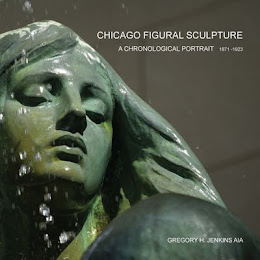
Her eyes are gently, serenely, closed. Her mouth turns slightly downward. But not in sadness. There is some determination here. Perfect confidence. And she is beautiful .
.
In a moment she will awaken. Smiling fully. Freely pouring water in abundance. To the end of time.
______________________