HENRY HERING. Regeneration. Compositions


Edward Bennett's four elegant Bridge Towers define and punctuate the Michigan Avenue Bridge. Each Tower has sculpture dedicated to an important event in Chicago's History. And each Sculpture, similar within a uniform composition, is strikingly varied. Like L'Arc de Triomphe. This is Paris on the Lake. The Burnham Plan of 1909.        
.

.
Henry Hering's "Regeneration" (and the remaining three, all subjects of future posts) follows "the drill:" variation within apparent symmetry and similar composition. Below are vignettes that summarize the work: Upper. Lower. Right. Center. Left. Each are compositions that could stand alone. Overlapping elements tie them together. (See Previous Post for Details).          
.


.
It must have taken some "talking" to get Hering on the South to agree with Fraser on the North, and William Wrigley, Fraser's benefactor to concur with the Benjamin Franklin Ferguson Monument Fund (administered by the Art Institute of Chicago), that financed Hering.      
.

But they did agree.  And we got the icing on the cake.


FOR MORE CHICAGO SCULPTURE, ARCHITECTURE AND ART VISIT


And here are two more links.
                  
and

Cityscape was started in 2006.  Public Art began in 2007 -- these blogs are years long commitments to Art and Architecture in Chicago.
.

HENRY HERING. Regeneration. Men at Work

With the Allegory of Regeneration explained (See Previous Post) and the clear knowledge that Mrs. Chicago has subdued the salamander, its time to see the details. No other Henry Hering sculpture in the Chicago area relies so heavily on details and props. Anvil, jackhammer, pulley, beam, gear, gloves, leather aprons, straps, rivets and workshoes all help "tell the story." The combination of movement and strength is remarkable.    
.


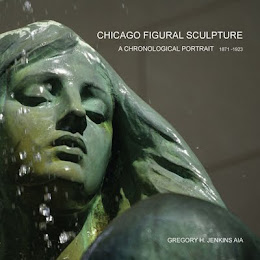
A very nice description of this Bridge Tower can be found in "Chicago's Public Sculpture" by Ira J. Bach and Mary Lackritz Gray. Available at Amazon. Link HERE. Let me also plug my own book, "Chicago Figural Sculpture" also available (on sale) at Amazon. Link HERE.

In 1928 the generation that remembered the Chicago Fire was beginning to disappear.  This Memorial marks an end of History and the beginning of Legend.

I'll be away for a few days (up in the frozen north) but will return with a few final thoughts on the composition of Regeneraton.

FOR MORE CHICAGO SCULPTURE, ARCHITECTURE AND PHOTOGRAPHY VISIT
.

HENRY HERING. Michigan Avenue Bridge. Southeast Bridge Tower. "Regeneration"

.
It always helps to have a clue.....
.

The Woman in the center of this composition, wearing a breastplate, is tough as nails. She is surrounded by shirtless men. One has a jackhammer. Another, I think, is doing the pasodoble, with his arm stretched under her cape. (She doesn't flinch.) On her head - a cap or crown - embossed with the words "I WILL." In her right hand, a builder's square. In her left, a roll of drawings. Above, a barefooted angel is blowing a huge horn. (Huge) And on closer inspection, we see that a lizard is disappearing under her skirt. At the corner of Michigan and Wacker.


Pictures don't lie.


I'll admit to calling on James L. Riedy and his book CHICAGO SCULPTURE for a little help. (Its available at Amazon,) (So is mine.) Henry Hering used the Charles Holloway sketch that won first prize in an 1892 Competition sponsored by the Chicago InterOcean for the centerpiece of his sculpture. She is the personification of Chicago. The "I WILL" on her crown is the City's motto. The builder's square and drawings show the way for the construction workers that surround her to rebuild the City in 1872. (That Dancer in the crochet hat is actually preparing to hoist a steel beam)              
.

And, by the way, that's no lizard. Mrs. Chicago has her foot on a salamander, a mythological spirit of fire. The Chicago Fire. She is clearly indomitable as the heraldic angel above announces the dawn of a new age.

How I love this place.

FOR MORE CHICAGO SCULPTURE, ARCHITECTURE AND PHOTOGRAPHY VISIT
.

HENRY HERING and JAMES EARLE FRASER. The Michigan Avenue Bridge

.
In 1920, with thanks due Daniel Burnham and Ed Bennett (although maybe not in that order), Michigan Avenue spanned the Chicago River. The Bridge, was, is, an elegant construction.  A double decked bascule punctuated with four Beaux Arts bridge towers. (More on this in  future posts at Chicago Architecture in the Loop.)  Henry Hering, commissioned by the Benjamin Franklin Ferguson Monument  Fund, sculpted "Defense" and "Regeneration" for the south Bridge Towers. James Earle Fraser, who was funded by William Wrigley, created "Explorers" and Pioneers"  for the North Towers.  Both had trained under Augustus Saint Gaudens, who had been an artistic advisor to the Columbian Exposition of 1893.

No group of sculpture in the City is more difficult to fully appreciate.  The symmetry and architectural impact of the bridge towers relegates these major pieces of sculpture to ornament.  The similarities of composition overshadow their differences.  And their high traffic location almost precludes the "quiet moment" that sculpture takes to understand.                      
.


Not that I'm not complaining very loudly.  These four pieces are entirely appropriate ornament for what is arguably the most important Bridge on the most important Avenue in the most important City between New York and the West Coast. Still, they each deserve time and care. More to follow.

FOR MORE CHICAGO SCULPTURE, ARCHITECTURE AND PHOTOGRAPHY VISIT

AMY ALDIS BRADLEY. LOUIS COMFORT TIFFANY. The MacArthur Foundation.

Thank Amy Aldis Bradley for the "idealized" Louis Jolliet at the Marquette Building. For more of the story visit the MacArthur Foundation's fine new website here.


It's not my imagination. This Native American does have a mustache. And looks, maybe, Italian??

HENRY HERING. Running Diana

Even history's very successful figural sculptors were not completely occupied with major commissions.  This smalll "Running Diana" is a work from the same Sculptor who is responsible for the two tableaux on the south towers of Edward Bennett's Michigan Avenue Bridge.


PHOTOGRAPH FROM THE COLLECTION OF THE SMITHSONIAN INSTITUTION. LINK TO THE ORIGINAL

Continuing comparisons from the previous post,  Hering's nudes are not the sensuous compositions that mark Lorado Taft's work.  This one shows great delicacy (and the influence of Hering's mentor, Augustus Saint Gaudens).   Both, however, worked side-by side with women in their studios.  Taft with Nellie Walker.  And Hering with his wife Elsie Ward, an accomplished sculptor in her own right.

.

PORNOGRAPHY. NUDES. Looky Here. A Post You Won't Forget!

I've received three phone calls since my last post: a list of Henry Hering's Sculpture in Chronological order. With no pictures. All three phone calls had the same gist: if you expect your blog to survive (ie "keep traffic") you're going to have to do better than that. Okay. I've read about this stuff too. Chicago Art Magazine knows the value a "sandbox fight." I, too, have seen them in action. (Argghhh. Grrrrr.) And there's the scare tactic. But its the day after Christmas and I don't feel so scary. And why even try when there's PORNOGRAPHY. Pornography always sells.

So in order to make up for that Hering thing, today I post NAKED MEN AND WOMEN and list them as "keywords." The photographs are a study of Lorado Taft's 1907 "Pastoral" at the Garfield Park Conservatory. The fern garden, today, was A VERY STEAMY PLACE.
.


We probably would have "gotten it" without the rabbit.  Come to think about it, Lorado Taft's work is  still "suggestive." Taft's "Fountain of the Great Lakes" actually brought about a review of the City of Chicago's Obscenity Ordinance. "Solitude of the Soul still evokes comment.   The additional publicity brought both fame and notoriety to Taft. Maybe, maybe the tactic will work again.

Taft and Hering had much in common.  Both are early twentieth century sculptors with significant bodies (another keyword) of work in Chicago.  Both worked in "Studios" with a team of sculptors:  Hering in the Cornish,  Taft at the Midway.  And both failed to make the transition to Deco.  (eg. failed to monetize their product). 

I'm glad I have a sense of humor.


.